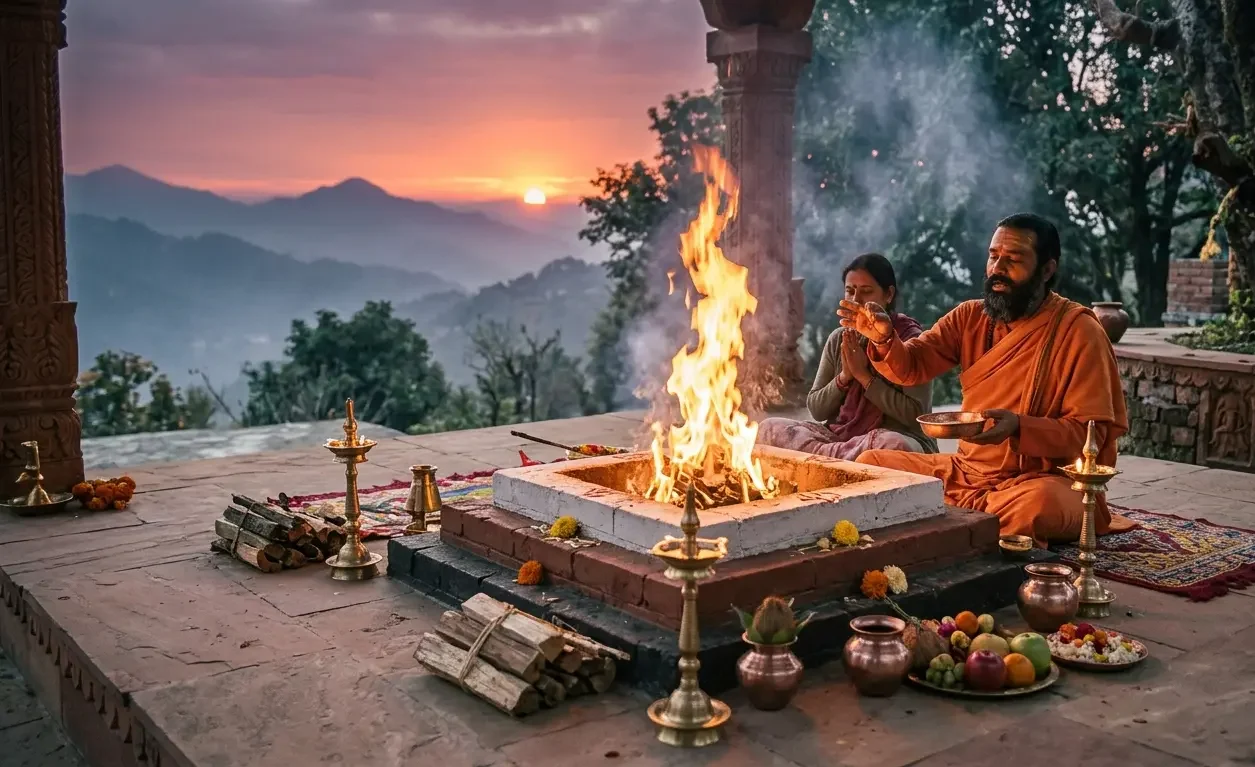
In the modern world, dominated by empirical science, digital connectivity, and modern technology, ancient rituals are often misunderstood or dismissed as superstitious relics of a bygone era. Among the most central practices of the Vedic tradition are Homas and Yajnas—sacred fire rituals that have been performed continuously for thousands of years.
To the untrained eye, a Homa (also known as Havan) or Yajna might look like a symbolic ceremony where grain, clarified butter (Ghee), herbs, and wood are burned in a structured pit while chanting Sanskrit mantras. However, when viewed through the combined lens of Vedic wisdom, quantum physics, environmental science, and neurobiology, these rituals reveal themselves to be sophisticated bio-cosmic technologies designed to harmonize human beings with their environment, purify the atmosphere, and elevate consciousness.
1. The Primordial Science of Agni (Fire)
In Hinduism, Agni (Fire) is not merely a chemical reaction involving heat and light. In Vedic philosophy, Agni is revered as the divine messenger—the intermediary between the physical realm (Sthula) and the subtle cosmic realm (Sukshma).
The Rig Veda—the oldest known text of humanity—begins with a dedicated invocation to Fire:
“Agni-mīḷe purohitaṁ yajñasya devam ṛtvijam, hotāraṁ ratnadhātamam.”
(I praise Agni, the chosen priest, the divine minister of the sacrifice, the hotar priest, the bestower of treasure.)
Why Fire?
Unlike water, earth, or air, fire possesses unique physical and metaphysical qualities:
- Transmutation: Fire is the only element that transforms physical matter into subtle vapor and energy.
- Non-Contamination: Fire remains inherently pure. While water can become polluted and earth can be soiled, fire consumes impurities without losing its intrinsic purity.
- Directionality: Regardless of gravity or wind, the flame of a fire always moves upward, symbolizing spiritual evolution, rising consciousness, and liberation (Moksha).
When medicinal plants, woods, and offerings are introduced into the fire during a Yajna, Agni acts as a high-speed molecular accelerator, converting solid organic materials into micro-particles, gases, and subtle subtle energetic vibrations.
2. The Atmospheric and Ecological Science of Yajnas
One of the primary benefits of performing a Homa is its profound impact on air quality and micro-ecosystems. At first glance, burning wood and offerings might appear to create smoke and pollution. However, the exact combination of materials and the temperature at which they combust in a Yajna pit produce a radically different chemical output than ordinary combustion.
The Material Chemistry (Samagri)
The offerings placed in the Yajna fire, known as Havan Samagri, are carefully selected organic substances rich in bio-active compounds:
- Ghee (Clarified Cow Butter): Rich in hydrocarbons and fatty acids. When combusted at high temperatures, Ghee produces volatile aromatic organic compounds that bond with toxic airborne particulate matter.
- Medicinal Herbs: Ingredients such as Guggul (Commiphora wightii), Camphor (Karpura), Cardamom, Sandalwood, Jatamansi, and Giloy release natural phytonutrients, terpene complexes, and essential oils.
- Sacred Woods: Samidha (firewood) from trees like Banyan (Vata), Peepal (Aswattha), and Mango (Amra) have inherent anti-fungal and antibacterial properties.
Air Purification and Micro-Disinfection
When Havan Samagri undergoes incomplete and complete combustion in the presence of Ghee, compounds like formic acid, acetic acid, and natural aldehydes are synthesized in trace amounts. These vapors act as powerful botanical disinfectants, neutralizing pathogenic bacteria, fungi, and airborne toxins in the surrounding environment.
Modern laboratory studies analyzing the air before and after a standard Agnihotra or Havan demonstrate a significant reduction in ambient bacterial counts, airborne mold, and sulfur oxides, proving that these ancient rites served as effective communal public health interventions.
3. The Geometry of Sacred Space: The Kunda
The construction of the fire pit, known as the Yajna Kunda, is governed by Sulba Sutras—ancient Indian texts dedicated to geometry and mathematical proportion. A Kunda is never built randomly; its shape, depth, and step angles are precise geometric formulations designed to contain, amplify, and channel electromagnetic energy.
| Kunda Shape | Associated Energy / Purpose | Symbolism |
| Square (Chaturashra) | Stability, Peace, General Well-being | The Earth element, grounded balance, and harmony |
| Circular (Vritta) | Health, Protection, Public Welfare | Water/Cosmic cycles, infinity, and protection |
| Semi-Circular (Dhanush) | Victory, Overcoming Obstacles | The Bow, targeted focus, and strength |
| Triangle (Trikona) | Transformation, Destruction of Negativity | The Fire element, focused spiritual intent |
The pyramid-shaped or inverted step design of the Kunda ensures that thermal energy is focused toward the center, creating an ideal temperature gradient that optimizes the vapor distillation of herbs while preventing smoke dispersements from becoming overwhelming.
4. The Neuroscience of Mantras and Sound Vibrations
A Homa is incomplete without the rhythmic chanting of Vedic Mantras. While the physical fire works on the material and atmospheric planes, the sound frequencies of the mantras work on the subtle brain states and bio-magnetic fields of the participants.
Sonic Resonance and Neuromodulation
Sanskrit is a phonetically structured language designed around acoustic resonance. The pronunciation of specific syllables stimulates specific meridian points on the roof of the palate, which in turn triggers activity in the hypothalamus and pituitary glands.
- Alpha Wave Induction: The synchronized, rhythmic chanting during a Yajna alters brainwave activity, shifting participants from high-stress Beta waves to calm, reflective Alpha and deep Theta brain states.
- Neurochemical Balance: Listening to and participating in structured Vedic chanting encourages the release of endorphins, serotonin, and GABA, reducing cortisol (the stress hormone) and inducing a state of meditative tranquility.
When sound waves (Mantras) intersect with light energy (Fire) and olfactory stimuli (Aromatic Smoke), it creates a sensory environment that enhances focus, mental clarity, and emotional resilience.
5. The Metaphysical Philosophy: Yajna as a Life Template
Beyond the physical, chemical, and biological benefits, the concept of Yajna forms the core philosophical pillar of Vedic life. The word Yajna comes from the Sanskrit root Yaj, which means to worship, to connect, and to sacrifice for the greater good.
  [ Individual Ego / Tyaaga ]  --->  ( The Sacred Fire )  --->  [ Cosmic Harmony / Yajna ]
              |                                                           |
              +------------------ Unselfish Service ----------------------+
The fundamental philosophy of a Yajna teaches us:
- The Principle of Interconnectedness (Rta): Everything in the universe functions through a reciprocal cycle. The sun gives heat, the clouds give rain, the soil gives food, and humans must offer back gratitude and protection. A Yajna is a ritualistic acknowledgement of this universal law of give-and-take.
- Selfless Offering (Idam Na Mama): During a Homa, after offering every grain or drop of Ghee into the fire, the practitioner chants: “Idam Agnaye, Swaha… Idam Na Mama” (“This belongs to Agni, not to me”). This is a profound psychological practice in letting go of ego, possessiveness, and attachment.
- Environmental Stewardship: A Yajna reminds us that we do not own nature; we are caretakers of it. By cleansing the air, feeding the unseen microbial life, and projecting peaceful intentions, we give back to the elements that sustain us.
6. Integrating Homas and Yajnas into Modern Life
In our fast-paced modern routines, it is easy to view these elaborate Vedic rituals as impractical. However, the ancient sages designed adaptable forms of these rituals—such as Agnihotra, a simple 10-minute fire ritual performed precisely at sunrise and sunset—specifically for daily household practice.
By bringing the practice of Homa into modern homes, families can:
- Create a Stress-Free Sanctuary: Regular fire rituals help neutralize electromagnetic stress from electronic devices and restore mental equilibrium.
- Purify Living Spaces: Natural herbal vapors act as chemical-free room purifiers and pest deterrents.
- Cultivate Mindfulness: The focus required to tend the fire, chant mantras, and present offerings acts as an active form of meditation.
Conclusion: Bridging Ancient Wisdom and Modern Reality
Far from being archaic idol worship or wasteful combustion, Homas and Yajnas represent a timeless science—an exquisite synthesis of chemistry, bio-physics, acoustic engineering, geometry, and spiritual philosophy. They reflect a deep understanding of nature’s subtle laws that modern science is only now beginning to uncover.
When we reignite the sacred fire with knowledge, reverence, and understanding, we do not merely honor our ancestors; we adopt a proven method to heal our environment, quiet our minds, and align our spirit with the universal order.
To learn more about authentic Vedic rituals, astrological remedies, and ancient spiritual science, visit vaidikpuja.org.